Exhibitions
Kilmainham Gaol Museum Permanent Exhibition
Ongoing
The main exhibition at Kilmainham Gaol Museum tells the story of the social and political history of the prison. Three main themes are explored on three levels of the exhibition space:
- social history of Kilmainham Gaol and Irish prisons in the 1800s
- the history of Irish nationalism and republicanism, 1796-1924
- the restoration of Kilmainham Gaol in the 1960s
The ground floor looks at the Gaol through the eyes of the ordinary prisoner. A prison register records the offences for which men, women and children were locked up, from violent assault to stealing apples from an orchard. Also on show are the small wooden box in which the convict John Sheahan carried his possessions to Australia in 1842, and a Victorian Gandolfi camera used to take prisoner mugshots.
The first floor turns to rebellion, nationalism and the road to independence, covering the period from the 1798 rebellion to the end of the Civil War in 1924. Highlights include Robert Emmet’s 1803 proclamation of a provisional government, the last letter written by Charles Stewart Parnell, and scapulars taken from the body of Michael Collins after his death in 1922. The Last Words section displays the final letters and personal belongings of the fourteen leaders of the Easter Rising executed here in May 1916.
The top floor recounts how a group of volunteers rescued the near-derelict Gaol in the 1960s and restored it as a monument to the men and women imprisoned or executed here in the cause of Irish independence.
Kilmainham Gaol Museum Temporary Exhibition
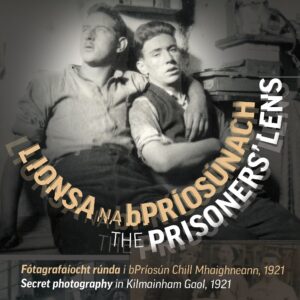
The Prisoners’ Lens: Secret photography in Kilmainham Gaol, 1921
23 October 2025 to 31 October 2026.
The OPW presents a new exhibition of secret photographs taken in Kilmainham Gaol in 1921 during the War of Independence.
The prisoners took them using cameras smuggled into the prison, and they capture ordinary life inside the Gaol that year: boxing matches, Irish language classes, religious services and drama productions, men sunning themselves in the south-facing yards, cooking in the kitchen and playing with two dogs they had somehow acquired.
The men were released on 8 December 1921 after the signing of the Anglo-Irish Treaty. British Pathé News filmed their release, creating the earliest known footage of Kilmainham Gaol — shown here for the first time as part of the exhibition.
Letters written by the prisoners are also on display, including several from Vincie Lawler explaining to his mother how to smuggle film and developing paper into the Gaol hidden inside a tin of sweets.
Admission to view the exhibition is free.