The Chapel
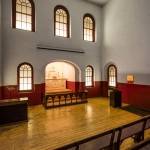
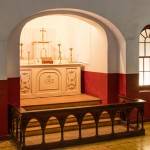
Two chapels sit inside the walls of Kilmainham Gaol — one Catholic and one Protestant — and only the red-walled Catholic chapel on the first floor is open to visitors today. Its wooden altar was made in 1882 by a Belfast carpenter, James Lalor, who was an inmate at the time. Depending on how strictly they were isolated, Sunday Mass here was sometimes the only occasion on which Catholic prisoners saw one another.
The chapel is best known for the wedding of Joseph Plunkett and Grace Gifford in May 1916, celebrated by Father Eugene McCarthy just hours before Plunkett’s execution. The room was lit only by prison-issue candles, the couple were required to stay silent apart from their vows, and two soldiers acted as witnesses.
The West Wing
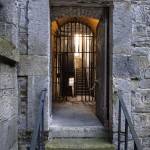
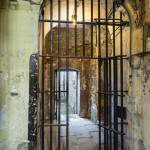
Two symmetrical wings flanked a central block when the Gaol opened in 1796. Only the West Wing survives in its original state, making it the oldest part of the building. It now holds seventy-nine cells, though there were fewer at first — extensions were added across the nineteenth century. It is a gloomy, cold place; when first built the windows had no glass, and there was neither heating nor light.
Members of the United Irishmen were held here after the rebellions of 1798 and 1803. Leaders of the Easter Rising — among them Patrick Pearse, Thomas MacDonagh, Constance Markievicz, Thomas Clarke and Michael Mallin — were confined in this wing, as were women Republican prisoners during the Civil War.
It was also the setting for the celebrated 1921 escape of Ernie O’Malley, Simon Donnelly and Frank Teeling. Earlier in its history the West Wing housed the worst-off prisoners, including people jailed for stealing food during the Famine and those detained under the Vagrancy Act.
The East Wing
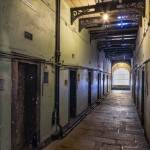
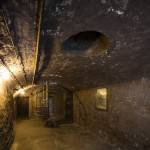
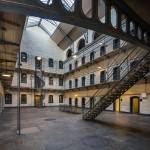
Built in the 1860s to a design by the architect John McCurdy, the East Wing embodies Victorian prison theory. Modelled on Jeremy Bentham’s Panopticon, all ninety-six cells are visible from a central platform. Light was central to the design: an enormous skylight was meant to flood the hall with what was thought to be cleansing sunlight, while each cell window was set too high to see out of, encouraging inmates to look heavenward. Punishment took place in near-total darkness in a handful of underground chambers. Fenians were imprisoned here in the late 1860s, and many prisoners in this wing went on hunger strike during the Civil War.
The wing is probably most familiar from the screen, having served as a location for Michael Collins, In the Name of the Father and, more recently, RTÉ’s Rebellion.
The Stonebreakers’ Yard
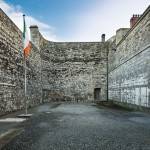
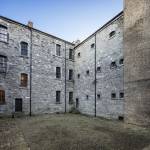
The most famous yard in Kilmainham Gaol was originally a place of hard labour. Huts once lined the walls so that prisoners could work in isolation; they no longer survive, but their outlines are still visible in the ground. Men sentenced to hard labour spent their time here breaking stones by hand, while women given the same sentence worked in the laundry.
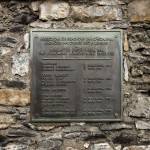
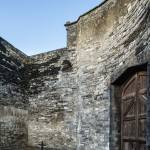
Fourteen leaders of the Easter Rising were executed in this yard in May 1916. A plaque and two crosses commemorate them today.